3D Printing Log Book: A Practical Tool for Tracking Progress and Innovation
The 3D Printing Log Book is a structured, printable resource designed for individuals engaged in 3D printing projects. It serves as a detailed record of the design, testing, and refinement processes involved in creating 3D-printed objects. This log book is particularly useful for hobbyists, educators, engineers, and entrepreneurs who want to maintain a clear and organized documentation of their work. Its format allows users to track project milestones, note challenges, and document solutions, making it an essential companion for anyone working with 3D printing technology.
Unlike generic notebooks or digital apps, the 3D Printing Log Book offers a physical, tangible space for recording information. This can be especially beneficial for those who prefer handwritten notes or who want to avoid screen fatigue during long design sessions. The log book’s layout is optimized for clarity, with sections dedicated to project details, material choices, printer settings, and results. This structure ensures that users can quickly reference past work and build upon it efficiently.
What Makes the 3D Printing Log Book Unique?
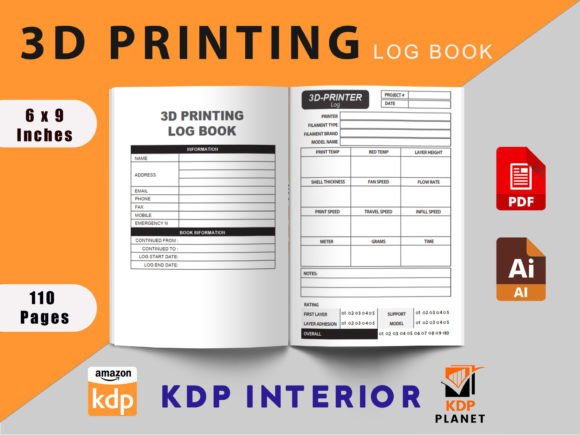
The 3D Printing Log Book stands out due to its tailored design for 3D printing workflows. It includes specific fields for tracking critical parameters such as filament type, nozzle temperature, layer height, and print speed. These details are essential for troubleshooting issues and optimizing print quality. By maintaining a consistent record, users can identify patterns and make informed adjustments over time.
Another distinguishing feature is the inclusion of space for sketches, diagrams, and photographs. This visual component allows users to document the evolution of their designs and provide context for their decisions. Whether you're experimenting with new materials or refining a complex model, the ability to capture visual elements enhances the value of the log book.
The log book is also designed with practicality in mind. It is available as a PDF file, making it easy to download, print, or upload directly to platforms like Amazon KDP. This flexibility ensures that users can access and customize the content according to their needs. Additionally, the editable source file in Adobe Illustrator provides further customization options, allowing users to adapt the layout or add personal branding if desired.
Comparing the 3D Printing Log Book with Other Options
When considering tools for documenting 3D printing projects, the 3D Printing Log Book offers a unique blend of simplicity and functionality. Digital alternatives, such as spreadsheet templates or specialized software, may provide more advanced features like automated data tracking or cloud storage. However, these tools often require a learning curve and may not offer the same level of tactile engagement as a physical log book.
For users who prioritize portability and accessibility, a digital log might be more convenient. However, the 3D Printing Log Book’s physical format can be advantageous in environments where internet access is limited or where a hands-on approach is preferred. It also eliminates the need for ongoing software updates or subscription fees, making it a cost-effective option for long-term use.
Other alternatives, such as general-purpose notebooks or custom-designed journals, may lack the specific structure required for 3D printing documentation. While they can be adapted for this purpose, they often require additional effort to organize and maintain. The 3D Printing Log Book, by contrast, is pre-structured to meet the needs of 3D printing enthusiasts, saving time and reducing the risk of missing key information.
Strengths and Limitations of the 3D Printing Log Book
The 3D Printing Log Book excels in providing a straightforward, user-friendly way to document 3D printing activities. Its clear layout and focused content make it easy to use, even for beginners. The black-and-white format ensures that it is suitable for printing on standard paper, while the 6 x 9-inch size offers a comfortable reading and writing experience.
One limitation is that the log book does not include color pages or bleed areas, which may be a consideration for users who want a more visually appealing design. However, for most practical purposes, the black-and-white format is sufficient and helps keep production costs low. Additionally, the absence of bleed means that the design is optimized for direct printing without the need for additional trimming or formatting.
Another potential tradeoff is the lack of built-in digital integration. While the log book is compatible with Amazon KDP and other platforms, it does not offer real-time syncing or backup capabilities. Users who rely heavily on digital tools may find this limiting, but for those who prefer a more traditional approach, it is a non-issue.
When the 3D Printing Log Book Is the Right Choice
The 3D Printing Log Book is ideal for individuals who want a reliable, no-frills method of tracking their 3D printing progress. It is particularly well-suited for educational settings, where students can use it to document experiments and learn from their experiences. In professional environments, it can serve as a reference for teams working on iterative design projects, ensuring that all members have access to a shared record of development.
For small business owners or independent creators, the log book can help maintain consistency across multiple projects. By keeping detailed records, users can streamline their workflow, reduce errors, and improve overall efficiency. It is also a valuable tool for those who want to share their knowledge or create tutorials, as it provides a structured framework for explaining the design and printing process.
Additionally, the log book is a good fit for users who value simplicity and do not require advanced features. It is an excellent choice for those who want to focus on the creative aspects of 3D printing without getting bogged down by complex software or technical jargon.
When to Consider Alternatives
While the 3D Printing Log Book is a strong option, there are scenarios where alternative tools may be more appropriate. For example, users who work with large-scale or high-volume 3D printing operations may benefit from more robust documentation systems that support automation and data analysis. In such cases, digital tools or custom-built solutions may offer greater scalability and efficiency.
Users who frequently collaborate with others may also find that a digital platform provides better sharing and version control features. Cloud-based solutions allow multiple users to access and update a shared document in real time, which can be more efficient than managing physical copies of a log book.
Finally, those who prefer a highly customizable experience may appreciate the ability to tailor their documentation system to their specific needs. While the 3D Printing Log Book offers some flexibility through its editable source file, it may not provide the same level of personalization as a fully customizable digital template.
Conclusion: A Versatile Resource for 3D Printing Enthusiasts
The 3D Printing Log Book is a practical and effective tool for anyone involved in 3D printing. Its structured format, ease of use, and compatibility with various platforms make it a valuable addition to any 3D printing workflow. Whether used for personal projects, educational purposes, or professional development, it offers a reliable way to track progress and refine techniques.
By understanding its strengths and limitations, users can determine whether the 3D Printing Log Book aligns with their needs or if another solution may be more suitable. Ultimately, the choice depends on individual preferences, project requirements, and the level of detail needed for documentation. With its clear focus on usability and practicality, the 3D Printing Log Book remains a solid option for those seeking a straightforward way to manage their 3D printing endeavors.